Introduction to an Imaginary Book
“What I shall have to say here is neither difficult nor contentious; the only merit I should like to claim for it is that of being true, at least in parts.”
By these words, J.L. Austin opened a book entitled How to do Things with Words. I am reminded of it as I open the present one, but only to increase the scope of the disclaimer: I cannot even say that parts of what I shall have to say are true, only that I have to say it, and have made reasonable efforts to avoid obvious falsities. That it is all conjecture should be appearant enough; that the ideas are not radically new can be inferred from the fact that the questions broached here are central to philosophical thought since the Vedas1. So, rather than an original or academically relevant philosophical proposition, this essay could be construed as the description of a personal intellectual trajectory, were it not for the circumstances of its writing, which are as follows.
For this book, I would like to blame Ajuni Héloïse Bargel Rai, my 6-month-old2 daughter, who in spite of her short time on Earth3 had already managed to effect major changes on its orbit, at least from where I sat. Consequent to the rise of an apparently unquenchable instinct to care for her, a serious lack of sleep had interrupted the more difficult (and contentious) enterprises of my ripening years, and, unable for a time to write poetry or fiction, I had resorted to turning to philosophy (hence already losing in stylistic grace, as this formulation shows) to feed that other starving baby which otherwise, if neglected, wails like the Sirens of Odysseus, and which sits in my skull. The original draft (available for sale, contact my agent) shows the inordinate hours of conception: first and last, against reason when rest was so vital a need, trains of thought loaded with distant memories, receding into foggy vales, reappearing sometimes over there, sometimes down here, and sometimes not.
Only towards the end did I realize that everyone has been talking about this, in one way or another, throughout the history of insomnia, and much before the advent of the functional MRI. After a small bout of discouragement, for I would never be able to address properly each and every one of these esteemed writers, my dismay turned to hope: that because it has been such a popular topic, it is likely an interesting one, and because it has not ceased to be a popular topic, although a lot is being repeated unwittingly, there must remain something to say, and in effect, to justify what is really a personal need to say it, just go ahead and say-ay it4, I am now able to conceive that just adding a small contribution, not as progress but as a reminder that it is still there, to a much broader enterprise which, actually, contains in itself many fields and courses of study, and tends to bypass them all, entirely falls within my purview as a man of letters.
Indeed, if we consider, as he did, Kant’s reversal of the subject-object relation as aptly compared to Copernicus’ substitution of Sun and Earth in their rotation around one another, maybe what I am doing here, insisting that if our knowledge stops at the limits of our rational and non-rational categories, there is still a reality beyond that pulls us in a certain direction, is aptly comparable to maintaining that for me, for all my perceptions and purposes (practical, ethical, and soteriological), the Sun does revolve around the Earth within a universe in the center of which I reside, and its revolutions produce many colors. That there is such a universe, and that it may actually contain the one which science describes, may be more a matter of faith than demonstration. But faith has always tolerated argumentative discourses, especially when they stop; and the kinds of words which I assemble, sometimes intending to “do things” with them, are perhaps best defined as that which remains of language when the urge to argue has subsided, when the orators take a rest, have a drink, and start making out with each other. Carpe Diem, motherfuckers!
I am here and soon, I won’t. So I would like to make some noise. From as high as I can atop the tree where I have been destined to live. In truth, then, quite far from an original or academically relevant philosophical proposition, not even close to the description of a personal intellectual trajectory, the pages that follow would be best defined as the ramblings of a monkey.
-
Or, if these are not as old as some say, “since the dawn of humankind”. ↩
-
At the time: she says she’s not a baby anymore. ↩
-
At the time… ↩
Time as Imaginary Phenomenon
In today’s world, we are used to many ways of measuring and counting time on a linear scale, to the point that we imagine this measurable, linear time to be a dimension of the universe, similar to those of space; we believe this linear, measurable time to be a fact of nature, demonstrated by science. But this is not a notion of time derived from our experience: processes observed by humans in nature are often cyclical, at various scales, and their definitions are largely incompatible with the mathematical modes of measure inherent to linear time, as we shall see with more examples involving humans and bananas.
The abstraction called “linear time”, useful as it may be as a convention, does not derive from our experience of observing nature, but rather from our experience of measuring certain aspects of it. Like the observation of processes, this activity of measuring them also has practical purposes (more or less precisely predicting the return of cyclical phenomena, for instance, by projecting them on a linear plane1), but adds, to the characteristics of the human observer mentioned above, the characteristics of the instrument of measure, in defining the objects and their states which can be thus described. This rather reduces the scope of linear time to certain activities where measuring is important; and does not offer, that I can see, good reason to extrapolate its modalities to constituting a factual dimension of the universe.
Instead, after further discussion, I would like to offer some thoughts about linear time being a fiction based on an instrument of measure, and that in analyzing the more general notion of time which arises from our experiences as humans in nature, we may discover that time does not exist outside of specific processes, the most important of which, to us humans, would be our own consciousness.
-
such as the physical ones of a globe on a flat map ↩
Existence of Time, from a Banana
Exploring the idea that time is an abstraction derived from the observation of physical and physiological processes.
Processes are defined as the changes of an object from one state to one or more other states.
Defining “objects” and “states of objects” implies an observer with a set of characteristics that inform these definitions.
Say, a human being can observe a banana (object) and its change from being ripe (state 1) to rotten (state 2), and does so usually with a practical purpose in mind: eating the banana as is, making a banana cake if it is overripe and you have more than one, feeding it to a pig if you have one nearby, throwing it away and counting on garbage collection or biodegradation to replace you in attending to this banana until its final purpose, which is not to exist as a banana anymore. A certain interest in bananas, as well as commensurate scales of existence, a physical relatability, are supposed in the human observer.
The observation of processes implies the existence of observers with cognitive abilities: perception, definition, comparison.
Exploring the idea that from these observations, humans derive an abstraction (concept, notion) called “time”.
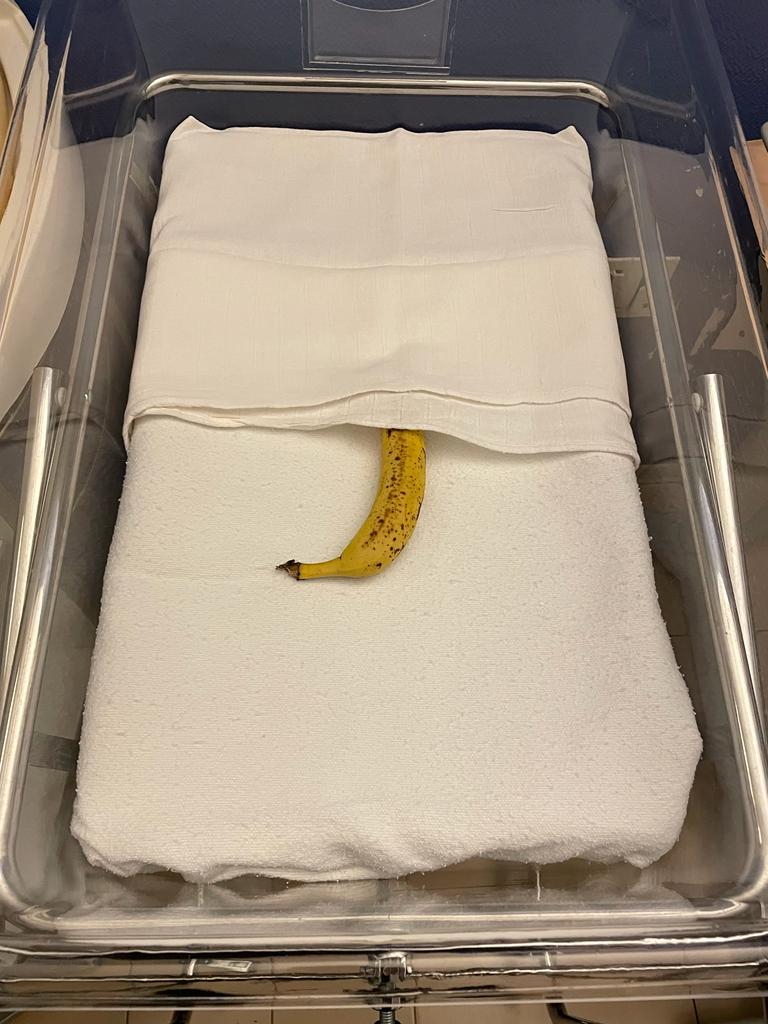
Existence of Time for a Banana
Process of the banana: growth and decay.
I don’t know that a banana has consciousness. I only know that there is a substance, a particular arrangement of molecules, which I recognize as yellow and phallic in shape, and call “banana” (in English, and some other languages).
This banana exists as a process of growth and decay. The object “banana” and the states which compose its existence in time are defined by a human observer; nonetheless, there is good reason to believe that unobserved bananas behave similarly in the wild: they grow, usually on a banana tree, ripen, are eaten and/or decay.
Without needing to assign consciousness to our banana, we can say that it exists as a process, a succession of ordered states, from which we may derive a notion of “banana time”, or “time for the banana”, bounded by its lifecycle and related to other bananas, to the longer cycle of the banana tree, and related natural cycles as we are able to observe.
This does not mean “time to the banana”: just for fun adopting a banana’s point of view, time may not appear in itself. There is a continuous process, ever present, of being something that changes. To conceive some sort of time, one needs memory, to compare one’s present state with a former one, and skills of comparison and calculation, to judge let’s say by the cycles of sunlight how one’s changes are proceeding. In my short time as a banana, I have not felt the need for such complicated matters, rather enjoying the sunlight from my elevated position on a tree, the tightness of my skin on my growing, fleshy bulge.
Interaction with human processes
A banana can enter the processes of one or more human beings, based on interactions that these intend to have with it. Humans cultivate bananas, grow them to sell them to be transported and eaten or transformed in banana-derived products that are then eaten or otherwise consumed. The banana becomes situated in a time defined by these processes, which are human activities, bounded by their own characteristics, external to the banana itself.
It so happens that human activities tend to exist at a scale which is compatible with the lifecycle of bananas: “human time” and “banana time” can easily be correlated, even giving the impression that they both exist within a larger time which is just “time”. We shall keep this question aside for now.
Interaction with bacteria
Typical bacteria have a lifespan of 12 minutes, which, among many possible fates, they very well may spend entirely on the peel of a banana. Imagining one such bacterium (singular), existing as its own process, its own succession of ordered states from which we derive a notion of “bacterium time”, it may not relate to the banana1 as partaking in time. The “banana for the bacterium” entity is likely to seem eternal, fixed and unchanging, a monolithic background to all relevant activity.
Although it may be more relevant to consider bacteria at the scale of a “colony”, which is a visible mass of them grown from a single cell. The time scale of a colony would be more compatible with that of a banana, and its processes potentially more relevant.
Having quickly reached a limit in my ability to think about bacteria, let me reveal my hand: I meant to consider an object, existing in relation to a banana, whose time-defining process would be so short (in banana time) that it would make the banana seem “eternal”, a bit like the universe seemed to humans before we started finding ways to measure it.
For a process A (lifecycle of a banana) to be relevant to a process B (lifecycle of a bacterium), there would need to be a change of states in process A (from A1 to A2, or A23.5 to A23.6) that would somehow impact a change of states in process B. For instance: the young banana having ripened, a new nutrient becomes available to the bacterium (the definition of states depends on the observer: here, a change in the banana that is relevant to the bacterium).
If all of process B happens within a state of process A which cannot be distinguished by B from another state of process A, then with regard to process B, A is not a process but a constant. If for the bacterium, within its lifecycle, the banana does not change, then it does not exist in time: it is eternal in bacterium time.
Interaction with quasar
- For an entity situated 30 billion light-years from Earth, consisting as far as we can tell in a mass equivalent to billions of our Sun, and which, as it keeps increasing at a rate far surpassing the scale of our solar system (“swallowing” thousands of suns every second), emits a rather powerful electromagnetic radiation, our little banana may barely register as existing. Even if we consider the banana to be included, as the tiniest of minuscule fractions, in the mass and energy interactions of that entity with its surroundings, I am willing to hypothesize that the time processes relevant to the banana, any and all of them, are not relevant to the quasar. No change that happens in a time relevant to the banana (its own process or those others in which it is involved) seems likely to impact a change of states in the quasar.
- Granted, a quasar is not directly observable by humans, and is “perceived” only through very specific measurements and calculations, which lay far beyond the scope of this train of thought (and of my own knowledge). A sun may have sufficed, as a projection of an object, existing as its own process, to which banana time would not be relevant.
- Relevance similarly defined as a change of states in one process impacting a change of state in another process.
- Granted, a quasar is not directly observable by humans, and is “perceived” only through very specific measurements and calculations, which lay far beyond the scope of this train of thought (and of my own knowledge). A sun may have sufficed, as a projection of an object, existing as its own process, to which banana time would not be relevant.
- A banana would seem eternal to the bacterium, inexistent in time to the quasar (a bit like a speck of dust is not a moment in time to us).
- Derived from a daydream, this discourse on banana time intended to show, from the point of view of time as processes, how the process of one object (banana!) could be insignificant to the processes of other objects: unrelatable for reasons of scale, excessively small or large in comparison. This would mean that these objects do not, cannot exist in time together. What time is to each of them is not mutually compatible.
- This would restrict time to being an emergent phenomenon for internal observers, absent for (hypothetical) external observers.
- Yet my argument is itself limited by the choice of “extremely small” and “extremely large” comparison points: in doing so, I adopted a [“time is space” metaphor] in order to visualize the incompatibility of internal notions of time based on processes. This may be helpful as a transitory, intellectual tool, but:
- it also restricts drastically the types of incompatibility that may be imagined (besides scale, there could be many ways for two objects of being irrelevant to each other’s processes?),
- and uses a visual, thereby implicitly linear, continuum in which these processes “exist”, and possess “scale” relative to each other. This presupposes (unsurprisingly, since I am a human with certain inherited thinking habits) the notion of a linear time as “a factual dimension of the universe” which I was precisely attempting to avoid by focusing on processes and how time “arises” from them.
- (and introduces a distinction between “eternal” for “irrelevant by larger size” and “inexistent” for “irrelevant by smaller size” which may not matter: we could say that anything irrelevant to a process is “outside of time” for this process, regardless of how it is irrelevant; for instance if you ask what my time was at the last New York City marathon, which I didn’t run)
- Nonetheless, parts of these speculative examples may begin to suggest — and my failure to escape traditional projections indicate continued difficulties — what is this idea of time as an abstraction of observed processes, and what it implies if we can consolidate it.
- Yet my argument is itself limited by the choice of “extremely small” and “extremely large” comparison points: in doing so, I adopted a [“time is space” metaphor] in order to visualize the incompatibility of internal notions of time based on processes. This may be helpful as a transitory, intellectual tool, but:
- You may now eat the banana.
-
in whichever way it relates to the banana, about which I don’t know much: bacteria, despite being made of only once cell, display an impressively vast range of behaviors ↩
Causality as Imaginary Phenomenon
Idea: because our perception presents things to us one after another, our brain postulates a relation of cause and effect.
Counter-idea: our perception presents things to us one after another because our brain cannot process everything at the same time (thus time seems to slow down when many things happen that our perception transports to our consciousness). It isn’t necessary that things happen one after another; it could also be that, among a set of eternally co-present things, we create different paths that seem to depend on time, but only create an impression of it. (Same as with a non-linear set of textual fragments: going from one to another by one of the possible paths creates a succession, but an arbitrary, non meaningful one; yet which is necessary in order to go through what there is (as we cannot read everything simultaneously)).
Arbitrary, non meaningful succession, even if subsequently analyzed into beginning, middle and end, cause, meaning and effect. Afterwards, we may evaluate its relevance, but it was in any case conceived. What is conceived, even if later disproved, knows a kind of existence and persists, imaginarily, after its disproval.
Raindrops at the Airport
Waiting to be called for boarding, I looked out the window: it was raining quite heavily. Water shone on the tarmac, punctuated by a myriad impacts of raindrops, which were forming circles of different and varying diameters, based, presumably, on the size of each individual raindrop. As far as I am aware, these are overall distributed randomly. At first sight, in any case, I could not perceive any pattern or regularity in the rapid succession of raindrops hitting the existing layer of water on this particularly flat surface.
But I tend to spend time in abstract thought, or daydreaming, or imagination, and if my surroundings make no further demands on my attention, after a while my eyes tend to unfocus. It is a common phenomenon of decreased visual accommodation, maybe particularly frequent in people with ADHD or autism. Since it often happens to me, I have learnt to pay attention to it, that is, to observe what occurs in my visual field without refocusing my gaze. In this case, what was striking was: the raindrops seemed to form a pattern. Among all the impacts, which I continued to perceive, three of them seemed to draw a triangle, that is, to fall every time in the same places, not with the largest impact but a quantitatively significant one nonetheless, at regular intervals, in such a way that isolated the shape of a triangle within the continuing multiplicity.
Still assuming that raindrops fall in a random pattern, it was then my brain which was isolating a pattern within the chaos, probably twisting reality just enough for that purpose. Human brains are quite well trained to do this: simplify a chaotic reality into shapes that can be computationally processed for practical purposes. Here, when I was paying attention, the lack of practical purpose for me in there being or not a pattern in the falling raindrops, associated with my scientific knowledge or belief that this was not the case, kept that pattern-making process below the level of my consciousness, as being unuseful: I was not seeing a pattern. With my attention diverted, indirectly considering the visual field, my brain continued its low-level processing and, by a small interstice in the synthesis of consciouness, I was able to observe it: how a pattern had appeared. This suggested that some of what I consciously perceive as patterns may be complete constructions of my perceptual and perception-processing systems, and that I may not generally be able to distinguish those from actual patterns present in the physical world. Some patterns that I see are there, some are not there.
What was even more striking: of these three, two raindrops would often fall at a very short interval from each other, and that seemed to create a movement, from one to the other, as if instead of separate raindrops falling from above, it was the impact circle that moved, along one of the sides of the triangle, at a very fast speed. I have since read something similar in the “beta phenomenon”, first identified by Wertheimer in 1912: if shown two dots in two different places in very quick succession, we will “see” the dot moving from one place to the next, including seeing it in a middle position where no dot actually ever was. In a more humorous fashion, I have a very fast dog of the whippet breed, and once a lady, after commenting on his beautiful coat, exclaimed “oh, but you have two of them!”, because Odin had run so fast in a circle behind her and back on the other side, it made more sense that there be two dogs instead of just one that ran so, so fast (mind-blowingly fast!).
In these examples, someone’s brain either creates a relation of causality where there is none, or because the actual one is “unbelievable”, imagines two beings where there is only one. Why do I say “causality” instead of “movement”? Well, one can consider movement as the most basic form of causality (departure of object from point A causes arrival of object at point B); one can also consider causality as a concept constructed from the observed phenomenon of movement (object arrives at B after departing from A and traveling for a time t). If two things happen one after the other in time, it is probably because one caused the other, we think. (Cause and effect as an artificial subset of reality.)
Patterns that are not there are not much less there than those who are. Rain drops can be perceived as forming a triangle, by a brain in a certain state, because that brain has a tendency to create causal relations out of everything, which it processes (and we perceive as “happening”) in succession (to itself, succession as defined by its own sequential way of processing input).
Because our perception presents things to us one after the other, our brain postulates relationships of cause and effect. These may be confirmed or not in later processing, but those that are not exist almost as much as those that do.
Perception and Reality
Some patterns are there, some are not there. That some are not there doesn’t mean that none are there. Nonetheless, the reality of a pattern is still predicated on my mode of perception; that others agree, that it can be measured, only mean that we have this mode of perception in common, and a measuring instrument that we created for it, to condition our agreement to an external, conventional, criterion.
So this light on the construction crane that blinks once, then twice, then once, then twice, is really there, but saying that does not mean more or less than the fact that I am here, with a mind that has notions of numbers and succession, able to interpret a visual phenomenon under the form of this pattern. There are phenomena and I can count: so I will interpret this phenomenon by a count of it. Surely the phenomenon possesses a countable attribute for me to count; but that does not mean that I can believe thus to possess its definition. It may have, probably has, many other aspects that other perceptual agents find convenient to them. So when I say : “it blinks once, then twice, and so on”, I only mean : “I can count a visual stimulus from there once, then twice, and so on.” That is, unfortunately, all that I can perceive. Far from defining the object, this remark exhausts my ability to perceive it.
When I talk about the world, I am still talking about myself. When I describe the world, I describe its shadow (on the cave wall, have at it) through a very specifically shaped sieve: it tells me that there is a world, but the shape of what I see tells me about the sieve.
Love and Hormones
When I hold my baby in my arms, I feel pleasure within myself and tenderness toward her. The rate of the hormone oxytocin in my bloodstream is increased. Which of these two phenomena is the cause, which the effect?
Pleasure and tenderness are feelings, phenomena which I experience physically and emotionally, of which I am conscious, and which “make sense” to me in terms of definitions and relationships within a personal history. (She is “my” child, I “love” her, etc.)
Increased oxytocin is a physiological phenomenon, unconscious and yet measurable, which is commonly conceived of as “producing” an “effect” of pleasure and tenderness.
But what produces the producer? What raises my oxytocin? The fact that I am holding my baby, whom I love. Preceded by the fact that I decided to hold my baby, be it in response to her call or out of my own appetite for cuddle.
Moreover, even though the oxytocin “makes me” feel good, and incites me to continue holding my baby, I can put her down in her cot if I decide to, if I need or want to do something else. So I am not mechanically destined to continue responding uniformly to physiology. But if I decide to continue holding my baby, my body will produce more oxytocin.
It seems that behavioral (conscious decisions) and physiological (varying hormone levels) phenomena continuously feed off each other, infinitely being each other’s cause and consequence, which makes them ultimately a single phenomenon progressing in time, rather than two phenomena linked by a causal relation, a view which appears only by artificially stopping time and distinguishing scopes according to our mode of observation.
Therefore, we could say that pleasure and tenderness are “associated with”, rather than “caused by”, an increased level of oxytocin in the bloodstream.
Instead of trying to determine causal relations between our physiology and our behaviors, it seems more accurate to consider our condition as “incarnation”, a continuously bidimensional existence, the ultimate logic of which or direction (whether or not I will hold my baby or not, keep holding her longer or not) cannot be reduced to either of these two (artificially distinguished) dimensions.
Perception and Consciousness
Many experiments in neuropsychology show that our consciousness is the result of a “best guess” by our brain, based on what previous experience allows it to infer and interpret from the stimuli that it receives. Consequently, our consciousness can be tricked in believing, for instance, that a fake hand is part of our body, as shown in [this video](https://www.youtube.com/watch?v=lyu7v7nWzfo). In this way, it can be said that: “We don’t just passively perceive the world, we actively generate it.” (ref)
This makes it necessary to distinguish, more than we are used to, our consciousness from reality. We experience reality through our perception, and this process is in large part defined by the inherent structures of our biological being (brain and body). Firstly, we can only perceive certain aspects of reality, through certain perceptual instruments that determine what these aspects are (where they are located and what type of data they can convey). Secondly, unconscious processes, based on this perception, select and shape what reaches our consciousness. Our interface with reality is both conscious and unconscious : we cannot equate our consciousness with that interface, let alone with reality. The unconscious part remains, by definition, outside of our direct experience (or consciousness), but can be inferred from this kind of scientific experiments.
In the same way, scientific knowledge about reality can be established that is inaccessible to our consciousness. But although scientific methods reveal other aspects of reality, these are not less determined by the perceptual instruments (most often, machines, and the ideas used to build them) employed in the process. Ultimately, they also have to be brought to our consciousness, through a particular type of linguistic exposition (scientific discourse), to “exist” for us. Albeit this existence more abstract than consciousness, it is no less self-determined (and here I will leave aside further examination of science as a particular case of perception).
What we call “reality” thus appears to be in large part a human construct, and this large part is all we know, and could ever know, of the world. Of the world, we only access what our selves construct, in both conscious and unconscious ways from our perception. What we conceive of as “real” is the conscious part of this self-determined process of accessing the world through very specific means.
Editorial Subnarratives and Overinterpretation
When I finish reading a news article and, at the bottom of it (if not interspersed within the article itself), a presumed algorithm suggests “to me” three other articles that “people who read this article were also interested in”:
- it is possible that their selection results from an algorithm that compiles the behaviors of all readers and attempts to guide me toward my genuine interests, based on past browsing, reading time, socio-demographic profiles, etc.
- it is also possible that some deliberate intention or purpose is at play in that selection, like on ecommerce sites where paid advertisements offer other products similar to the one I have been browsing, but chosen in the interest of the seller, based on available stocks, for instance.
- it is obviously possible to combine the two points above for a variety of intents, as many organizations are busy doing as we speak, ranging from commercial entities to government agents.
Even absent a paid or ideologically determined intention, it is unavoidable that I make unconscious connections between what I just read and “what else is out there”, based on this small selection. My brain is set up to make comparisons and inductions from available data, permanently in the cognitive unconscious, occasionnally consciously.
For instance, after I finish reading about a terrible train accident in India that is leaving hundreds dead and hundreds more injured, I may be left with a feeling that this wouldn’t happen in France, where I live. It happens, but much, much more rarely, and therefore I feel safe and somewhat confirmed in my latent superiority complex toward less developped countries, as I am part of a “better” one. But then, the first article suggestion after that concerns a pedophile Catholic priest being condemned after having abused young children for decades with impunity and even a form of protection from his institution. The Catholic church is very much part of the traditional social hierarchy in France, of the same power structure that defines the country, including its position in the world order (following a period of profitable colonialism, of course). That there are such crimes within it, and that they are widespread and “covered up”, provokes anger and indignation.
Yet, here is the implied comparison for me: I could be in a poor country where such accidents are almost common, and I would be much less safe, or I can be here but there is a price to pay for that power structure which protects me: the individuals that have power in it can also rape me or my children, or abuse their position in a variety of ways. It’s a cost-benefit analysis. I just read at length about the train accident; I am getting a quick reminder of the pedophilia scandal (which I am free to explore further by clicking, but not free not to have seen as a suggestion). This is more likely to make me resigned or fatalistic about the pedophilia, seeing it as an unavoidable (regrettable, but not worth throwing everything away that goes with it) part of the power structure that protects me.
There could be other interpretations, based on one’s feelings about India, trains, Catholicism and raping children. My main point is: there is such an editorial subnarrative at play; I have not really signed up for it, when deciding to consult this article; someone can for sure influence it for various purposes. Even in old-fashioned newspapers, the composition of a page with different articles could (and was) used as a device for creating similar associations. “Social benefits fraud rampant” on the left, “Presidential candidate vows to limit immigration” on the right: not a word is written of the argument, but it is obviously there. Journalists can keep thinking that they are independant, and billionnaires can keep buying newspapers and hiring editors to do the overall composition. One only has not to make it too obvious, as it needs to remain mostly unconscious, or at least not cognitively disruptive (not going against values and assumptions of assumed readership).
Pepsi and Dead Babies
I had read about it as an example of where “conspiracy theories” intersect with marketing: “Pepsi is made with dead babies”. What an amazing proposition! Nonsensical, yet… Coca-Cola is made from a secret recipe; Pepsi is its competition; we don’t really know what is in these ubiquitous drinks made of brown liquid, whose brands are everywere around the world; and then, because it really doesn’t make any sense, we briefly imagine it as a confirmation of absurdity: large industrial tanks with countless dead babies infusing in brown water… It still makes no sense, but can one really forget such an image? I doubt it would have ever occurred to me, despite my vivid imagination, but now it’s there; even as an example of the most outrageous thing ever said, the image is still there in my brain. And with more or less intensity, mostly unconsciously, won’t it influence me a little bit the next time I have to choose between Pepsi and Coke?
“Don’t think of a pink elephant.” The inability of the brain not to picture something that is said, even negatively, is well known. The ability of some images to impress our brain more than others, regardless of their truth, is also appearant.
- [ ] Can it be quantified? Analyzed? look to advertisement theory?
- [ ] cf in [[Consciousness Explained, Daniel Dennett]] the part about vertical symmetry and fish; that is one relevant fact.
Could it be the Coca-Cola Company, paying one of these rogue PR firms, who would have spread such efficient nonsense? There is also the fact that “dead babies”, in the US cultural context, triggers association with the heated issue of abortion. I hadn’t realized that initially, since I am not from that context, even though I am familiar with large parts of it, am not deeply involved in some of its important issues (that are less interesting to me).
But when I researched this recently, for the sake of this project, I found out a much more tangible connection…
It so happens that, factually, that in 1973, cells from the kidney of an aborted or miscarried (it is unclear) human embryo were cloned for medical research, under the name HEK-293 (Human Embryonic Kidney). This immortalised cell line, as it is called, as since been used very widely for many kinds of research, including by a company called Senomyx which produced sweeteners (depositing a patent in 2008 that mentions HEK-293), PepsiCo having contracted Senomyx in 2010 to “explore the development of new sweeteners and flavor enhancers”. A religious sounding advocacy group called for a boycott of Pepsi based on the claim that Senomyx used “aborted fetal cell lines to test their product”, and in 2012 PepsiCo folded under that pressure and issued ass-covering statements, breaking their four-year contract with Senomyx. (need ref)
Not exactly dead babies macerating in melasses, but almost… not. This being said, it doesn’t really matter. Even unvalidated, once you have imagined the picture, which is necessary to evaluate it, it has existed in some capacity, and it will persist. Does it persist less vividly now that I’ve explored it more in details? I think so, which would be an argument in favor of academic research. A counter argument would be that having to explore all kinds of crazy crap like that would fill up one’s agenda; much more efficient to create your own competing images?…
Stories that exist without being true are potentials of our narrative brains. Once activated, that cannot unhappen, even if we can establish it to be “false”: not reality.
Storytelling and Dreams
Stories are successions of causality resulting in meaning; causality itself being fictional (being “invented” by our mind, in a way that is determined by our biology, certes, but aren’t other fictions also that? which is, circularly, what I am currently demonstrating), stories and meaning are also determined by our filter, are expressions of our sieve patterns, about a world, sure, but they do not say the world, they say what the sieve is. And that there is a world, unknowable through a sieve.
The most recent studies on brain activity while dreaming (refs) suggest that story telling, building narratives to interpret our experience of the world, is a default function of our brain, which operates freely during REM sleep (what we know as “dreaming”).
When we are awake, this narrative function is constrained by the input that we receive from reality: we cannot interpret our experience in a way that is completely contradictory with, say, physical reality. I cannot walk through walls in my waking life, while I completely can in my dreams. Other forms of reality — what we could call collective or consensual reality (that which a group of people agrees exists, is real, whether it is an object or an idea, or even a moral rule), also the internalized version of this collective reality, relative to our belief in what may or may not exist, which would be called credential reality — similarly apply more constraints that define the stories (or interpretations of the world and our experience in it) that we tell ourselves and that compose, in practice, most of our experience of the world.
All of this “reality” is a construct (except, in part only, the physical), and in particular abstract collective realities (social and moral norms) strongly limit our narratives, sometimes more than our actual situation justifies. In this case, the free narrative activity of the brain during REM sleep may provide us with a solution or an alternate route or vision, by reagencing the elements of our problems without any constraints.
- dreams, give example from letter
This shows how our narrative building is an internal brain function that runs, by default and when sleeping, by combination and association without care for reality ; and when awake, various realities come to constrain that functioning into more limited narratives, which is what we live by. We don’t know reality any more by it, except negatively: it is that which comes to limit our dreams. But we can’t measure that negative contribution, since most of our brain activity is unconscious: we can’t actually know how much and how reality limits this brain function, so we have no actual, specific knowledge of reality, except that it is there (that there is something there).
Phenomena as Incarnation
Everything that I know about phenomena is determined by my act of knowing; everything, except that there is something there, and that I am. Time and space are consequences of my processing structure, and meaning is conditioned to arbitrary successions of perception or reading. But the fact that something is (in ways that I don’t know, which may have nothing to do with space and time) does not depend on me.
Everything, structured as it is, arbitrary as it is, is an indication of being both in and beyond everything.
Head of the Guru
As she drinks her milk bottle, baby Ajuni keeps looking at the Guru’s picture, across from her on a shelf. Her mother and my wife, Sukriti, appears moved by this sight, evidently drawing a spiritual conclusion from this display of spontaneous interest, whereas I, noticing that the upper part of the picture presents a perfectly round, white skull on a black background, make a comment about high contrast pictures attracting, as is well known, a baby’s gaze. For that, I receive a look of silent disapproval from Sukriti, as this isn’t the first time that I smile at the small miracles of her quotidian, which she interprets as disrespectful and inherently cynical, disbelieving of me. Yet, think I:
That there be, as her reaction seems to presume, a contradiction between the material realm (the visual abilities of a newborn and the characteristics of an image) and the spiritual (to muse that one’s baby is spontaneously attracted by that which one worships), that would be the sad thing! That a rational explanation contradict our miracle or, on the contrary, that to enjoy the wonders of the spirit one have to disavow reason, and all hope is lost.
That the divine incarnate materially, it’s at least amusing. This person that she considers as being “God”, which we must accept in principle as a spiritual belief, this person has indeed existed as a human being, with all the humility of the flesh (having sometimes an itchy butt, etc.). It isn’t negating the former to assert the latter, and if it deserves a reaction, rather than indignation I would suggest a smile: if we have a notion of God, that he sometimes be human, completely human, is pretty funny (unless one sticks crosses everywhere, which isn’t the case here). I like to think that he would smile at it also.
More seriously, an absence of separation between, in this case: 1) the fact that this baby, exposed for the first time to this image, in the arms of her mother who venerates it, pays it noticeable attention; and 2) the fact that this image possess specific visual characteristics, certainly intended by the photographer who (as this is a picture signed and gifted by the Guru) was part of the efferent religious organization, characteristics which attract the gaze of a newborn and, differently, of adults (I have also observed it more than once, as this skull, extending from the features of the Guru’s face, becomes a rather primordial, geometrical image, a white half-circle on a black background); this absence of separation would precisely be what is meant by an incarnation of the divine. A complete correspondence, in reality, between two aspects that are only separated by analysis (and this distinction, the fruit of a forbidden fruit, may cause regret): this is faith, and it works pretty well as long as the analysis isn’t false (although it is preferable to direct one’s thoughts, rather than to analysis, toward imaginative domains where true and false don’t exist), and as long as the aforementioned religious organization does not excessively consist in mercantile manipulation (even if there is some “staging” of the object of veneration, as long as it aims to help a spiritual approach, rather than controlling or exploiting individuals).
It still remains that this notion of a “man-God”, the incarnation of the divine in a man made of flesh and blood, entails a vast cultural incomprehension. Not that, ironically, it were at all foreign to my Christian culture, but because for the past two thousand years, Jesus’s disciples have fiercely maintained that he was the only one (which in itself, from the point of view of professional gurus, is quite impressive as far as post mortem performances go). Jews, while promoting the possibility of such an event, consider that it hasn’t happened yet. We live in a definite scarcity of divinity, over here, in spite of these prophets that are a bit godly, but not all the way; whereas in India, the abundance of avatars (which are punctual incarnations of multiple gods, themselves facets or reiterations of the same God, in a summarized Hinduism, obviously much more complex in reality) may seem to us a bit excessive, raising doubts as to their authenticity… Which is rather funny, as from their point of view, the admiration that we have for Jesus is manifestly exaggerated, as miracles like his are so frequent to be almost common, and the divine nature of some extremely “accomplished” individuals is uncontested and obvious… So, it is a quite reciprocal incomprehension!
But that God be in each of us, it is an easier idea to accept (as long as the notion of “God” makes sense to us; but every spiritualism, every recognition of a “shared humanity”, of a “person” worthy of respect, etc., also “exists in each of us”). We wouldn’t quite know how to quantify this presence, but can easily conceive that some of us, saints, “charismatic” celebrities, deserve a qualitative, superior designation. This does not make them “God”: the “pure” divinity remains of another realm, “beyond”, after death or an apocalyptic reconciliation in which we would all partake, even those of us who are not saints. Since “we live only once”, well, we wait for the end. You see what I’m hinting at… With reincarnation (the idea of successive lives) the obvious limitations of our present existence do not preclude the next one from being better, and the next one. If God is a little bit in each of us, but not completely, and if it seems impossible to reach him entirely in one lifetime from where we currently are (which most of us might think of ourselves), we can still try to make some progress, as much as we can, and in the next life we will start closer, and make more progress, and in time, sooner or later the perspective of entirely joining in (“becoming”) God is conceivable.
And as the world is very old, logically there are some among us have already reached that stage, and we honor them for it. They are our “gurus”, entirely human but also, in the process of their current incarnation, which is their last, reaching into the entirely divine. Having realized that, they use their remaining time to help each of us in our own progression, before retreating from the cycle of existence. There is not “scientific truth” to this: we cannot confirm or demonstrate the relation to the divine of our Guru, we can only, if we feel this relation to be relevant to our own heart, put our faith in it. Someone else will see God somewhere else; that is fine; some may be wrong or wronged, as fake prophets also exist; but that doesn’t change the heart of the matter, the possibility of that genuine process.
We honor those among us who we perceive to have reached this state of attaining the divine, and we think and decide which models to apply for ourselves. Personally, I think I’ll need at least one more life to reconcile my inner divinity and my outer existence. Unless I can reach it in this life, who knows, that’s anyways an encouraging idea: if I don’t make it before dying, I’ll have a head start in the next class. And in that hope of mine, there is all the more veneration for those who have made it, and all the more recognition of God in everyone.
God and I
It is possible to call what is in and beyond what is “God”. It is actually convenient. “God” is a word that does not mean anything, a placeholder for something that you cannot define, and might as well mean everything (as long as we don’t mean by that a countable totality).
God is incarnated in everything, if incarnation is a mode of apprehending beyond analytical. That there is something does not depend on the fact that I am. That I am does not depend on the fact that I am. This commonality is all that I can know, that does not depend on the nature of my knowing.
Like a tree toward the light, we in our lives grow toward God (at best; we can also writher and die). It does not last forever: even a tree eventually exhausts its growth, having accomplished all that a tree can, and all that this specific tree could, in this setting, with these ressources, neighbors, imponderables, etc. And that’s okay: the fact that it ends and we don’t know why this is so, why we are here exactly either, what all this means, doesn’t change the fact that the quality of our life is measured by inner yardsticks, crossing through layers of meaning, not by any external accomplishments.
Can we, having identified that all our experience is shaped by our consciousness, release the pressure of such shapes and open up more completely to the light? Which shines both outside and inside of ourselves, which are equally ourselves and not ourselves.
By definition, we can’t really have an experience not shaped by consciousness… But the indication of a beyond would be more potent if we don’t believe that the content of consciousness is reality.
To an extent, that is an individual teleology; strive to grow.
Jun 7th, 2023. 00:02. I am God; in that the only part of myself that I care to call “I” is that through which God shines.
So when I die I also don’t die.
(when my body dies, all that is left of me is, if I have succeeded, already God and in God, so nothing changes)
01:20 a big orange moon with a grin on it 😄
07:28 It is a truth that you can’t know. But that doesn’t mean that you should consider what you can know to be the truth. Keep pointing at the truth. Keep chanting the Name of God.
Conclusion
What you can do is work on determining what helps and what doesn’t help foster this truth, in you and in the world around you.
I think it starts with discarding the false truth, the illusions of self and knowledge.
Believing the self to exist is the same as believing your consciousness of an object to be the object.
The only valid knowledge is non-knowledge (“I only know one thing, that I know nothing.”; “By learning more, I am extending the scope of my ignorance.”)
To an extent, studying is an activity that contributes to a more accomplished non-knowledge.
Death
Dying is not what we wish. It is heretofore an unpleasant prospect to the body, which can be delayed until this potentially changes, and if events allow. But all in all, living beings are born, grow, and die, are born, grow, and die. It is not scary, as all time is contained in the present anyway. Time is only the succession of relevant events. (Time and story are the same thing. There is also an outside of story, in the present moment.) It is not a necessity: there can be no relevant events, only being. And non-being.
“Why is there something rather than nothing?” Non-being shivering simultaneously with being. Where does this idea come from?
“shivering” might be revealing: is non-being always present to a human thinker because human thought is predicated on a perishable body? So even in the moment of contemplating being, we’re still aware of our death, which gives us a notion of non-being. Notion that we project onto other beings. But really, there is no non-being, just our future, but always potentially imminent, non-being alive. There is no end of the world, just the end of our life.
We can imagine non-being as death, as darkness (opposite of light), emptyness (more difficult already), all notions that are not actually non-being, but projections of our own nothingness (future, always imminent). There is really only being. That I know of…
22:40 Shivering: there is beauty in that, like the leaves of trees ruffling in the night outside my window.
I mean the leaves are like bells at a temple, calling attention to the present shiver.